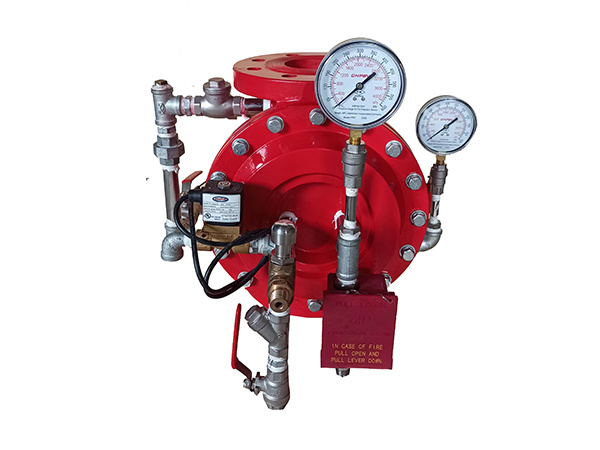
Deluge Valve
Categories:
Compliance Credentials: Strictly certified to UL 260 and FM standards for high-hazard critical infrastructure
TEL:
Deluge Valve
Manufactured by Ningjin APC Industries, the GY46X series represents the pinnacle of high-hazard asset protection, offering seamless global EPC tender compliance and robust integration into water-based fire suppression infrastructures.
1. Global Engineering & Certification Submittal Matrix
| Engineering Attribute | Technical Compliance Specification | Standard & Regulatory Reference |
|---|---|---|
| Main Valve Body Design | Straight-through cone diaphragm seal; single-chamber zero-clapper turbulency profile. | ASME B16.42-2016 Mandate |
| Flanged End Connection | Class 150 / Class 300 Raised Face (RF) | ASME B16.42 / DIN2501 PN16/PN25 |
| Grooved End Connection | Rigid cut-groove profile for commercial couplings | AWWA C606 / ISO 6182 Standard |
| Hydrostatic Pressure Ratings | Rated Working: 250 PSI / 300 PSI; Factory Shell Test: 500 PSI / 600 PSI | UL 260, FM 1011/1012/1013, FM 1020 Compliance |
| Operating Ambient Envelope | 4°C to 52°C (39.2°F to 125.6°F) constant load | NFPA 13 Installation Criteria |
| External Telemetry Interface | 3/4" NPT Reserved System Automation Port | Standard ANSI/ASME B1.20.1 Thread |
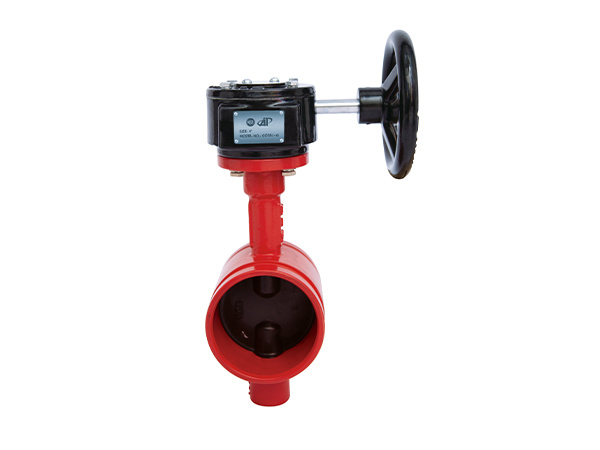
| Integrated Isolation Trim | Model GD381X Grooved End butterfly valve pre-configured with integral supervisory tamper switches | FM Global Datasheet 3-26 Approvals |
Advanced Metallurgical Traceability Log (BOM)
| Component Description | Base Metallurgy & Grade Configuration | International Standard Compliance |
|---|---|---|
| Main Valve Body, Manual Reset Valve, Emergency Pull Station | Ductile Iron Grade 65-45-12 (Tensile Strength ≥ 414 MPa, Elongation ≥ 12%) | ASTM A536 Standard |
| Butt Joints, Internal Check Valves, Directional Tees, High-Pressure Ball Valves, Y-Filters | Austenitic Stainless Steel CF8 / CF8M (Anti-pitting, anti-scaling over-molded profile) | ASTM A351 / ASTM B148 Standard |
| External Control Trim Seamless Pipes & Compression Fittings | Anti-Dezincification (DZR) Heavy Brass / Bronze Alloys C95400 / C95800 / C60800 / TP304 | ASTM A53 / ASTM A312 / ASTM B111M Reference |
| Surface Treatment Protection Layer | Fusion Bonded Epoxy (FBE) Thermal Coating (Internal & External Surface, Thickness ≥ 250 μm) | AWWA C550 Anti-Corrosion Compliance |
*Operational Restrictions: Optimized exclusively for clean industrial water and fresh firewater pipelines. Strictly NOT for deployment in Seawater, Crude Oil, Natural Gas, or High-Corrosive chemical fluid applications.
Global EPC Framework & Heavy Infrastructure Proven Record
With a record of over 300 successful international installations, Ningjin APC Industries has delivered unyielding fire safety systems across 100+ countries, including extensive municipal deployments in the Middle East, Brazil, Turkey, Chile, and Uruguay. The high-capacity deluge valve line, alongside certified fire alarms, gate valves, check valves, butterfly valves, and wet/dry fire hydrants, operates continuously in high-profile government engineering projects, aviation airports, critical medical facilities, corporate commercial towers, heavy manufacturing zones, and large-scale logistics parks.
2. Critical Fluid Mechanics & Site Lifecycle Operations
Q1: What are the critical ambient temperature and spacing boundaries for deluge valve installation requirements to prevent system delay or failure?
A: According to the factory specifications, the valve station must be installed in a regulated room maintained strictly between 4°C and 52°C (39.2°F to 125.6°F) to eliminate diaphragm freezing hazards. For optimal engineering layout, the station must be positioned as close to the protection target as possible. This directly minimizes the length of the downstream water distribution pipeline, thereby optimizing the total system response time during an emergency. For field technicians, mandatory service clearances must be reserved in four directions: a minimum of 1.2 meters from the front to the wall, at least 0.5 meters from both sides to the wall, and an elevated distance of 1.2 meters from the ground to allow unhindered maintenance.
Q2: Can the GY46X deluge valve body be mounted vertically, and what is the strict orientation requirement for its electric solenoid actuator?
A: Yes, the main ductile iron valve body is natively engineered to support both horizontal and vertical pipeline installations depending on the riser configuration. However, field engineers must ensure that the installation of the solenoid valve always keeps the solenoid core in a vertical position. Tilting or horizontally mounting the solenoid assembly alters the gravitational alignment of the internal core, which can cause mechanical binding or particulate trapping, directly compromising the remote electrical actuation efficiency.
Q3: During the post-actuation reset procedure, why does water continuously flow out of the drip valve drain hole, and when should it stop?
A: Continuous drainage during a reset indicates that the hydrostatic pressure between the upstream supply and the upper diaphragm chamber has not yet reached equilibrium. When you switch on the ball valve on the water injection loop and slowly depress the manual reset button, it is entirely normal for the reset valve to have water flowing out of the drain hole. This flow will stop automatically as soon as the trapped air is expelled and the pressure inside the diaphragm chamber increases sufficiently to compress the cone seal. Do not release the reset button until the indication values on the water supply pressure gauge and the diaphragm chamber pressure gauge are perfectly identical.
Q4: How do we execute the mandatory monthly operational check on the water motor alarm bell without discharging water into the sprinkler pipeline?
A: To perform an authorized partial test without wetting the protected hazard zone, technicians must utilize the integrated alarm test loop bypass. While the deluge valve bank is fully maintained in its ready condition, simply switch on the ball valve on the alarm test loop. This action redirects a controlled stream of firewater directly through the 3/4" NPT auxiliary system interface to actuate the water motor alarm bell or local pressure switches. Once the alarm telemetry is verified normal, switch off the ball valve on the alarm test loop to stop the alarm and return the system to standby.
Q5: What is the primary protocol for deluge alarm valve troubleshooting when the main valve seat suffers from severe sealing performance degradation after commissioning?
A: In practical deluge alarm valve troubleshooting, the root cause of post-commissioning seat leakage is almost always the failure to properly rinse the site infrastructure. The factory mandate dictates that before final valve coupling, all upstream pipes must be thoroughly rinsed until the drainage water becomes completely clear. If deposited sediment, welding slag, or sewage is left inside the line, it will settle on the EPDM cone diaphragm sealing surface during activation, creating permanent physical scoring or preventing the self-sealing cone from seating fully, which requires a complete shutdown and internal maintenance.
Product message
Related products
APC Industries
Mobile website
Add WeChat chat
CONTACT US
Add:No. 18 Taishan Road, Ningjin County, Shandong Province P.R.China
Mobile:+8618600252968
WeChat:cuiyuying01
E-Mail: