Selecting and Specifying Backflow Preventer Butterfly Valve: Engineering Guide and Model HGD-381X Technical Breakdown
time:
2026-10-26
Technical guide on selecting the Backflow Preventer Butterfly Valve, featuring UL/FM specifications, architectural breakdowns, and confusion analysis.

Fire Protection & Piping Systems
A Comprehensive Technical Guide to Engineering Selection, Confusion Analysis, and Municipal Standards based on Ningjin APC Industries specifications.
1. Core Architecture and Operation of Wafer and Grooved Butterfly Valves
A Backflow Preventer Butterfly Valve setup relies heavily on precision flow control architecture designed for high-pressure piping networks. Specifically, models such as the APC Industries HGD-381X series utilize a robust ductile iron body (ASTM A536) equipped with an EPDM encapsulated ductile iron disc.
Key Features & Technical Design
- Connection Standards: Grooved end and grooved-flanged end configurations conforming to ANSI/AWWA C606 or metric standard clear waterway designs.
- Pressure Ratings: Maximum working pressure of 300 PSI and maximum testing pressure of 600 PSI, conforming strictly to UL1091, ULC/ORD-C1091, and FM1112 standards.
- Temperature Range: Operates reliably within a working temperature range of 0 to 80 deg C (32 to 176 deg F).
- Top Flange Standard: Conforms to ISO 5211 for seamless actuator and gearbox mounting.
Material Specifications (Model HGD-381X)
- Body & Disc: Ductile iron body with EPDM encapsulated disc.
- Shafts & Bushings: 416 stainless steel upper and lower shafts paired with PTFE/C95400 stem bushings.
- Sealing & Hardware: EPDM shaft seals with WCB upper and lower shaft sealing nuts.
Important Operational Limitations
- System Isolation Requirements: Maintenance on either side of the valve requires shutting down the full pipeline section according to standard fire protection protocols.
- Torque and Actuation: Driven via an integrated supervisory signal gearbox featuring internal position monitoring switches.
2. Differentiating Easily Confused Valve Equipment
In engineering specifications, procurement, and on-site communication, three distinct devices are frequently misidentified under overlapping names. Accurate terminology is essential when procuring a Backflow Preventer Butterfly Valve:
1. Butterfly Check Valve (Dual-Plate Wafer Check Valve)

- Common Misnomer: Often colloquially referred to as a check-type variant of the valve system.
- Structure & Function: Features a slim wafer-style single body housing internal dual spring-loaded discs. It operates automatically to prevent backflow using pressure differential.
- Key Indicator: No handwheel or actuator. It is purely a non-return safety device, not a manual shutoff valve.
2. Complete Backflow Preventer Assembly (with Butterfly Shutoff Valves)

- Common Application: Frequently specified in fire protection blueprints and UL/FM project submittals.
- Structure & Function: A complete, integrated package comprising a central body (housing two independent check valves and a relief valve) flanked by inlet and outlet isolation valves.
- Key Indicator: A long inline assembly featuring a central body, test cocks, a pressure relief port, and two signal butterfly valves equipped with red gear operators and tamper switches.
3. Dedicated Fire Supervisory Signal Butterfly Valve (Backflow Isolation Valve)
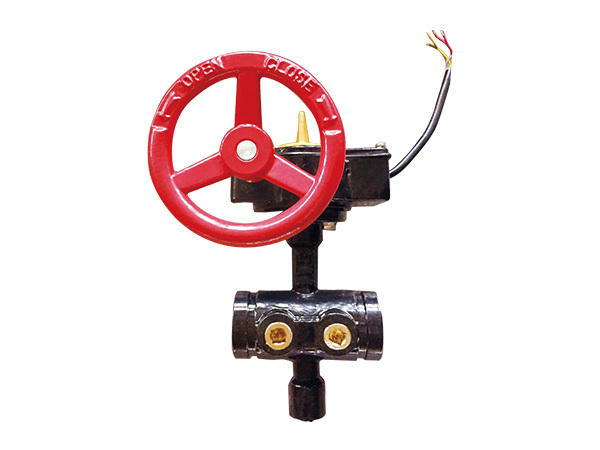
- Common Application: Used as the dedicated shutoff/isolation valve packaged with or paired to backflow assemblies (e.g., APC Industries Model HGD-381X / HFGD-381X series).
- Technical Specifications: Features a robust ductile iron body with an EPDM encapsulated disc, operating at a maximum working pressure of 300 PSI, with UL, CUL, and FM approvals. Handles temperatures ranging from 0 to 80 deg C (32 to 176 deg F) and incorporates an integrated supervisory signal gearbox with monitoring leads.
- Key Indicator: Black valve body, grooved or grooved-flanged mechanical connections, an upper red worm-gear handwheel, and electrical supervision leads (tamper switch).
3. Application Standards: Fire Protection vs. Municipal Drainage
It is worth noting that while fire protection models like the APC HGD-381X emphasize strict UL/FM certifications, 300 PSI ratings, and rapid position feedback for emergency systems, similar valve architectures are widely utilized in municipal drainage and sewage infrastructure under different standards.
When selecting a Backflow Preventer Butterfly Valve or isolation valve for municipal drainage, engineers typically look for AWWA standards (such as AWWA C606 groove specifications). These systems prioritize heavy-duty corrosion resistance—such as specialized protective epoxy coatings and NSF/ANSI 61/372 lead-free compliance—to ensure reliable long-term performance under raw water and wastewater conditions.
4. Quick Visual Identification Summary
| Product Type | Body Style & Color | Internal Structure | Operator / Control | Primary Function |
|---|---|---|---|---|
| Butterfly Check Valve | Flat, slim wafer body (Blue/Stainless) | Dual spring-loaded discs with central hinge pin | None (No handwheel) | Automatic directional flow prevention |
| Backflow Preventer Assembly | Long, multi-component inline assembly | Central housing with dual check cores + test cocks | Dual red-geared signal butterfly valves | Complete cross-connection contamination control |
| Supervisory Signal Butterfly Valve (e.g., APC HGD-381X) | Grooved/Flanged black ductile iron body | Ductile iron disc with EPDM encapsulation | Red worm-gear handwheel + feedback signal line | Main line shutoff with remote status monitoring (UL/FM) |
5. Frequently Asked Questions (FAQ)
Contact Information
Ningjin APC Industries Incorporated Company
No. 18 Taishan Road, Ningjin County, Shandong Province, P.R. China
Website: http://www.apc-valve.com/
Email: njcuishusheng@vip.163.com | rain.cui@apc-valve.com
Customer Service Contact
Contact Person: Ms. Cui
WeChat: cuiyuying01
Tel: +86 18600252968 | +86 534 5571078
Fax: +86-534-5216766
Recommended Reading
Content Feedback: We uphold a rigorous technical attitude. If you have any questions or find errors regarding the product technical parameters, standards, or descriptions compiled in this article, please submit your feedback through the following channel:
Technical Correction Feedback Email: weidong@apc-valve.com
Relevant news
APC Industries
Mobile website
Add WeChat chat
CONTACT US
Add:No. 18 Taishan Road, Ningjin County, Shandong Province P.R.China
Mobile:+8618600252968
WeChat:cuiyuying01
E-Mail: